

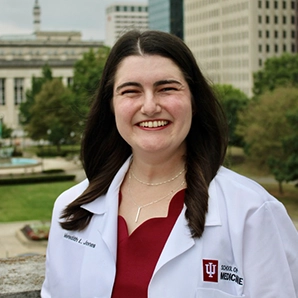
Why did you choose graduate school at IU Indianapolis?
I chose IU Indianapolis because of its strong collaborative environment and the opportunity to work with outstanding mentors who encourage both scientific curiosity and professional growth. IU’s breadth of expertise in neurodegenerative disease research—especially through the more than 75 researchers at the Stark Neurosciences Research Institute—made it an ideal place to pursue my interests. I also felt a strong pull in my gut that this was where I was meant to be. The journey hasn’t always been easy, but it’s been deeply formative and has strengthened both my resilience and commitment to science
What has been your favorite academic accomplishment since you’ve been here?
One of my proudest accomplishments was presenting my poster at this year’s Society for Neuroscience conference. I’ve always looked up to my mentors who presented there in the past, so having the chance to share my own work—at a meeting that drew over 20,000 attendees—felt like a true full-circle moment in my training. It was especially meaningful because the trip was made possible through support from the IUI Graduate School Travel Fellowship and the IUI Graduate Program Enhancement Grant (GPEG), whose funding enabled me to take advantage of this milestone opportunity.
What do you enjoy most about life in Indianapolis?
What I love most about Indianapolis is its perfect balance of energy and ease. There’s always something new to explore—whether a restaurant, a festival, or a vibrant neighborhood—yet the city still feels approachable and relaxed. Being just a few hours from major cities like Chicago makes it easy to get a change of scenery, while still having a place that truly feels like home.
Please provide some details about your work/research as a graduate student and/or any activities you are involved in.
My research focuses on kidney-brain crosstalk, specifically the role of Uromodulin (Tamm-Horsfall Protein, THP) in neuronal homeostasis. Beyond the lab, I’m passionate about mentoring and community building, having guided undergraduates through IUSM’s SUREBS program and high school students through the CTSI SEED/STEM Program. I also participated in IU’s Reverse Mentoring program, which pairs trainees with senior faculty to foster experiential learning. Being selected for the American Society of Nephrology Kidney STARS program provided an invaluable opportunity for professional development, allowing me to engage with the broader research community, attend conference, and gain insights that continue to inform both my research and mentoring.